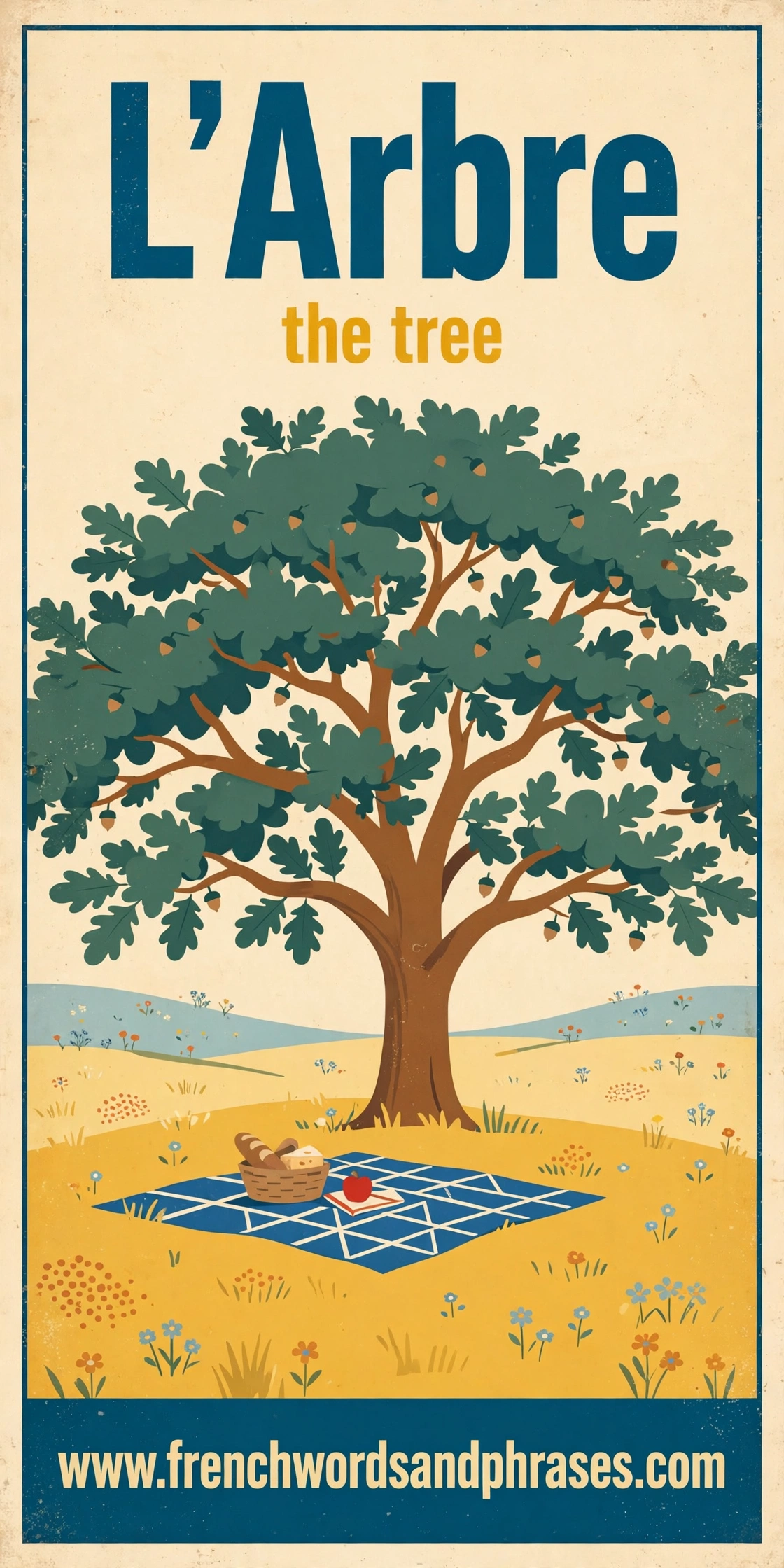
A French Word to Live By
Translate Arbre to English
/aʁbʁ/
L’arbre means a tree.
At the top of the village, one great tree spreads over the square — children play in its shade, old men argue beneath it, and every wedding photograph is taken against its trunk. It was old before the houses were built. That is l’arbre, the village elder.
In this guide, you’ll learn what arbre means in English, how to use it with its articles, how to form its plural, and how it appears in everyday French. Explore French examples, English translations, and practice quizzes.
Understanding the French Noun Arbre
Arbre is a masculine French noun. Because it begins with a vowel sound, its article changes shape: not le arbre, but l’arbre.
It means a tree. It is the tree you climb, the tree that shades the garden, the tree cut down for firewood and the one planted for a child’s birth. In French it also grows into family trees — un arbre généalogique — and into the Christmas tree, l’arbre de Noël.
Gender: Masculine
Definite article: le, written l’ before the vowel — l’arbre (the tree)
Indefinite article: un — un arbre (a tree)
Plural: les arbres (the trees)
English equivalents: A tree.
One important usage detail: arbre is masculine, even though it ends in -e and names something that feels feminine to many learners — say un arbre, le grand arbre, never la arbre. And because it starts with a vowel sound, le shrinks to l’: l’arbre. The same rescue comes with cet for this: cet arbre, not ce arbre.
Experience the Word
Arbre is more than a plant. It is time made visible — rings inside the trunk counting summers no one else remembers.
Imagine planting a tree for a newborn: a twig no taller than your knee. Twenty years later it shades the whole garden, and the child comes home and leans against it like an old friend.
You have not just planted a tree. You have given the future a place to rest.
How to Use Arbre in French: Complete Guide
Let’s explore how arbre works in French, beginning with its articles.
Arbre and Its Articles
French nouns are almost never used alone. The small word in front of the noun — the article — does a great deal of work.
Arbre with the Definite Article (L’, Les)
Used for a particular tree, or for trees in general. Before a vowel sound, le and la always become l’.
| Number | French |
|---|---|
| Singular | l’arbre |
| Plural | les arbres |
Example
L’arbre devant la maison a cent ans.
The tree in front of the house is a hundred years old.
Arbre with the Indefinite Article (Un, Des)
Used to count trees: one tree, or some trees.
| Number | French |
|---|---|
| Singular | un arbre |
| Plural | des arbres |
Example
Il y a un arbre immense au milieu du champ.
There is a huge tree in the middle of the field.
Arbre and the Vanishing Article (L’arbre)
There is no partitive for a tree — you cannot have some tree. Instead, arbre teaches a precious rule: little words melt into it — de l’arbre, à l’arbre, cet arbre.
| Meaning | French |
|---|---|
| the tree | l’arbre |
| of the tree | de l’arbre |
| to / at the tree | à l’arbre |
| this tree | cet arbre |
| my tree | mon arbre |
| the trees | les arbres |
Example
Les enfants jouent à l’ombre de l’arbre.
The children are playing in the shade of the tree.
Quick Quiz 1
Complete the sentence:
______ arbre devant l’école est très vieux. (le)
Reveal the answer
L’
L’arbre devant l’école est très vieux.
The tree in front of the school is very old. (Le becomes l’ before a vowel sound.)
The Plural of Arbre
Arbre simply adds an -s in the plural, and its article opens back out into les.
| Number | French |
|---|---|
| Singular | l’arbre |
| Plural | les arbres |
Example
En automne, les arbres perdent leurs feuilles.
In autumn, the trees lose their leaves.
Arbre with Possessive Adjectives (Mon, Ton, Son…)
Possessives agree with the noun, not with the owner. Arbre is masculine — and because it begins with a vowel, mon, ton and son flow straight into it.
| Owner | French |
|---|---|
| my | mon arbre |
| your (tu) | ton arbre |
| his / her | son arbre |
| our | notre arbre |
| your (vous) | votre arbre |
| their | leur arbre |
Example
Mon arbre préféré est le vieux chêne du jardin.
My favourite tree is the old oak in the garden.
Quick Quiz 2
Complete the sentence:
Il a planté trois ______ dans son jardin.
Reveal the answer
arbres
Il a planté trois arbres dans son jardin.
He planted three trees in his garden.
Arbre with Demonstrative Adjectives (Cet, Ces)
Used to point: this tree here, those trees there. Before a vowel sound, ce becomes cet.
| Number | French |
|---|---|
| Singular | cet arbre |
| Plural | ces arbres |
Example
Cet arbre donne les meilleures pommes.
This tree gives the best apples.
Arbre with Adjectives
Most adjectives come after the noun and agree with it; a few short, common ones — grand, vieux, jeune — come first. Vieux even changes shape before the vowel: un vieil arbre.
| Adjective | With Arbre |
|---|---|
| grand (tall, big) | un grand arbre |
| vieux / vieil (old) | un vieil arbre |
| vert (green) | un arbre vert |
| fruitier (fruit) | un arbre fruitier |
| feuillu (leafy) | un arbre feuillu |
| mort (dead) | un arbre mort |
Example
Un vieil arbre ombrage toute la cour.
An old tree shades the whole courtyard.
Quick Quiz 3
Complete the sentence:
______ arbre est immense. (ce — this)
Reveal the answer
Cet
Cet arbre est immense.
This tree is huge. (Ce becomes cet before a vowel sound.)
Everyday Expressions with Arbre
Arbre grows into sayings about family, patience and seeing the whole picture.
| Expression | In English |
|---|---|
| un arbre de Noël | a Christmas tree |
| un arbre généalogique | a family tree |
| l’arbre qui cache la forêt | the tree that hides the forest (the detail that hides the bigger picture) |
| grimper aux arbres | to climb trees |
| à l’ombre d’un arbre | in the shade of a tree |
| les arbres en fleurs | the trees in blossom |
Example
Attention à l’arbre qui cache la forêt !
Watch out for the tree that hides the forest — do not miss the bigger picture!
Words from the Same Family as Arbre
Learn these together and a whole landscape appears.
| French | In English |
|---|---|
| la branche | the branch |
| la feuille | the leaf |
| la racine | the root |
| le tronc | the trunk |
| la forêt | the forest |
| le bois | wood; a small wood |
Example
Les racines de l’arbre soulèvent le trottoir.
The tree’s roots are lifting the pavement.
Quick Quiz 4
What is un arbre généalogique?
Reveal the answer
A family tree
Elle dessine son arbre généalogique.
She is drawing her family tree.
Arbre in Everyday French: Real-Life Examples
Now that you know the word, let’s see how arbre appears in everyday French.
Example 1 — In the garden
Un pommier et deux cerisiers poussent au fond du jardin.
An apple tree and two cherry trees grow at the bottom of the garden.
Example 2 — In the park
Les enfants grimpent aux arbres du parc.
The children are climbing the trees in the park.
Example 3 — At Christmas
Nous décorons l’arbre de Noël en famille.
We decorate the Christmas tree as a family.
Example 4 — On a hot day
On déjeune à l’ombre du grand arbre.
We have lunch in the shade of the big tree.
Example 5 — In autumn
Les arbres du quartier deviennent rouges et dorés.
The trees in the neighbourhood turn red and gold.
Example 6 — Planting
Ils ont planté un arbre pour la naissance de leur fille.
They planted a tree for their daughter’s birth.
Beyond Translation: The Meaning of Arbre
English says tree for the meaning of arbre — a plain word for a thing France plants along every road and sets in every village square. The platane and the tilleul are not decoration; they are the ceiling of public life, the shade where markets, games of boules and long lunches happen.
An arbre is a promise kept slowly.
French even warns with it: l’arbre qui cache la forêt, the tree that hides the forest, is the detail that makes you miss everything else.
How to Remember the French Noun Arbre
Remember it this way: Arbre is masculine, and it swallows its article: l’arbre, never le arbre.
- You point at the big one in the square — l’arbre est immense.
- You draw your ancestors — tu dessines ton arbre généalogique.
- You hide from the sun — tu t’assieds à l’ombre d’un arbre.
The key idea is l’arbre for the tree, cet arbre for this tree, les arbres for the trees.
Test Your Knowledge of Arbre
Let’s see how much you’ve learned. Try answering these questions before revealing the answers.
Question 1
Is arbre masculine or feminine?
Reveal the answer
Masculine — l’arbre (le + arbre).
Question 2
How do you say this tree in French?
Reveal the answer
Cet arbre.
Question 3
Translate: An old tree shades the square.
Reveal the answer
Un vieil arbre ombrage la place.
Question 4
What does l’arbre qui cache la forêt mean?
Reveal the answer
The tree that hides the forest — the detail that makes you miss the bigger picture.
Question 5
Complete the sentence:
Les enfants jouent sous ______ . (the tree)
Reveal the answer
l’arbre
Les enfants jouent sous l’arbre.
The children are playing under the tree.
Your Final Challenge
Can You Use It?
How would you say this in French?
“There is a big old tree in my garden.”
Reveal the answer
Il y a un grand vieil arbre dans mon jardin.
There is a big old tree in my garden.
A little French. A little curiosity. A richer everyday life.
LEARN FRENCH ONE WORD AT A TIME